Calculus Review for Test Sections 2-1 to 2-4
1. Functions and Graphs
1.1 Review of Functions
Learning Objectives
- Use functional note to evaluate a function.
- Determine the domain and range of a function.
- Draw the graph of a part.
- Detect the zeros of a function.
- Recognize a office from a table of values.
- Brand new functions from two or more given functions.
- Describe the symmetry backdrop of a function.
In this department, we provide a formal definition of a role and examine several ways in which functions are represented—namely, through tables, formulas, and graphs. We study formal annotation and terms related to functions. We also ascertain limerick of functions and symmetry backdrop. Well-nigh of this material will be a review for y'all, simply information technology serves as a handy reference to remind yous of some of the algebraic techniques useful for working with functions.
Functions
Given two sets  and
and  , a set with elements that are ordered pairs
  , where
  is an chemical element of and
  is an element of , is a relation from to . A relation from to defines a relationship between those two sets. A function is a special blazon of relation in which each element of the first ready is related to exactly one element of the second set up. The element of the first set up is called the input ; the element of the second set up is called the output . Functions are used all the time in mathematics to draw relationships between ii sets. For any function, when we know the input, the output is determined, so we say that the output is a function of the input. For instance, the surface area of a foursquare is adamant by its side length, so nosotros say that the area (the output) is a part of its side length (the input). The velocity of a ball thrown in the air can be described equally a function of the amount of time the ball is in the air. The cost of mailing a package is a role of the weight of the package. Since functions have then many uses, it is important to have precise definitions and terminology to study them.
Definition
A role  consists of a fix of inputs, a set of outputs, and a rule for assigning each input to exactly one output. The fix of inputs is called the domain of the function. The set of outputs is called the range of the function.
For example, consider the function , where the domain is the fix of all real numbers and the rule is to square the input. And then, the input  is assigned to the output
  . Since every nonnegative existent number has a real-value foursquare root, every nonnegative number is an element of the range of this function. Since there is no real number with a square that is negative, the negative real numbers are not elements of the range. We conclude that the range is the set of nonnegative real numbers.
For a general function with domain  , we often use to denote the input and to announce the output associated with . When doing and so, we refer to every bit the contained variable and as the dependent variable, because it depends on . Using function notation, nosotros write
  , and we read this equation as " equals of ." For the squaring part described earlier, we write
  .
.
The concept of a part can exist visualized using (Figure), (Effigy), and (Effigy).
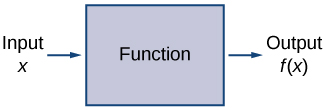
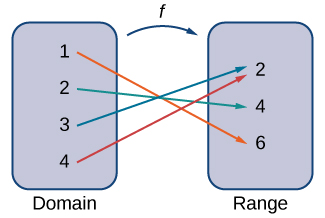
Visit this applet link to see more about graphs of functions.
Nosotros can as well visualize a function by plotting points in the coordinate plane where . The graph of a role is the set of all these points. For example, consider the function , where the domain is the set  and the rule is
  . In (Figure), we plot a graph of this function.
Every role has a domain. However, sometimes a part is described past an equation, as in , with no specific domain given. In this case, the domain is taken to be the set up of all real numbers for which  is a real number. For example, since any real number tin can be squared, if no other domain is specified, nosotros consider the domain of to be the set of all real numbers. On the other mitt, the square root office
  only gives a existent output if is nonnegative. Therefore, the domain of the part is the set of nonnegative real numbers, sometimes called the natural domain.
For the functions and , the domains are sets with an space number of elements. Clearly nosotros cannot listing all these elements. When describing a set with an infinite number of elements, it is often helpful to use set-architect or interval notation. When using set-builder notation to describe a subset of all real numbers, denoted  , nosotros write
 .
.
We read this as the set of real numbers such that has some property. For case, if nosotros were interested in the prepare of real numbers that are greater than one but less than 5, nosotros could denote this gear up using set up-architect notation by writing
 .
.
A set such as this, which contains all numbers greater than  and less than
  , can also be denoted using the interval notation
  . Therefore,
 .
.
The numbers 1 and five are called the endpoints of this ready. If we want to consider the ready that includes the endpoints, nosotros would denote this set by writing
![[1,5]=\{x|1\le x\le 5\}](https://opentextbc.ca/calculusv1openstax/wp-content/ql-cache/quicklatex.com-701c39404934e94bb4d21a6f4bd85e2f_l3.png "Rendered by QuickLaTeX.com") .
.
Nosotros tin use similar notation if nosotros want to include i of the endpoints, just not the other. To denote the set up of nonnegative real numbers, we would use the ready-builder notation
 .
.
The smallest number in this set is zero, but this set does non have a largest number. Using interval annotation, we would use the symbol  , which refers to positive infinity, and we would write the set up as
 .
.
It is important to annotation that is not a existent number. It is used symbolically here to betoken that this set includes all real numbers greater than or equal to zero. Similarly, if nosotros wanted to describe the gear up of all nonpositive numbers, we could write
![(−\infty ,0]=\{x|x\le 0\}](https://opentextbc.ca/calculusv1openstax/wp-content/ql-cache/quicklatex.com-3423e5bb6e08c069529dedd98a5b1499_l3.png "Rendered by QuickLaTeX.com") .
.
Hither, the notation  refers to negative infinity, and it indicates that nosotros are including all numbers less than or equal to nix, no thing how small. The prepare

refers to the gear up of all real numbers.
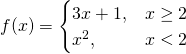
Some functions are defined using different equations for dissimilar parts of their domain. These types of functions are known as piecewise-divers functions . For example, suppose we want to define a function with a domain that is the set of all real numbers such that  for
for  and for
  . We denote this part by writing
 .
.
When evaluating this office for an input , the equation to utilise depends on whether or . For case, since  , nosotros use the fact that for and see that
  . On the other hand, for
  , we utilise the fact that for and come across that
  .
.
Evaluating Functions
Finding Domain and Range
Solution
- Consider
 .
. - Since is a existent number for any real number , the domain of is the interval
 .
. - Since
 , nosotros know
  . Therefore, the range must be a subset of
  . To show that every chemical element in this set is in the range, nosotros need to show that for a given in that prepare, there is a real number such that
  . Solving this equation for , nosotros see that we demand such that
  .
.This equation is satisfied as long every bit there exists a real number
such that .
.Since
 , the square root is well-divers. We conclude that for
  ,
,  , and therefore the range is .
- Since
- Consider
 .
. - To find the domain of , we need the expression
 . Solving this inequality, nosotros conclude that the domain is
  .
. - To find the range of , we note that since
 ,
,  . Therefore, the range of must be a subset of the set
  . To prove that every element in this set is in the range of , we demand to show that for all in this ready, there exists a existent number in the domain such that . Let
  . And then, if and only if
  .
.Solving this equation for
, nosotros run across that must solve the equation .
.Since
, such an could exist. Squaring both sides of this equation, we take  .
.
Therefore, we demand ,
,which implies
 .
.We but need to verify that
is in the domain of . Since the domain of consists of all existent numbers greater than or equal to  , and
, and ,
,there does exist an
in the domain of . We conclude that the range of is .
- To find the domain of
- Consider
 .
. - Since
 is divers when the denominator is nonzero, the domain is
  .
. - To detect the range of , we need to find the values of such that at that place exists a real number in the domain with the property that
 .
.Solving this equation for
, nosotros find that .
.Therefore, every bit long every bit
 , there exists a real number in the domain such that . Thus, the range is
  .
.
- Since
Find the domain and range for  .
.
Solution
Domain =  , range =
Representing Functions
Typically, a part is represented using i or more than of the post-obit tools:
- A table
- A graph
- A formula
Nosotros can identify a office in each form, but nosotros tin can also use them together. For instance, we can plot on a graph the values from a table or create a table from a formula.
Graphs
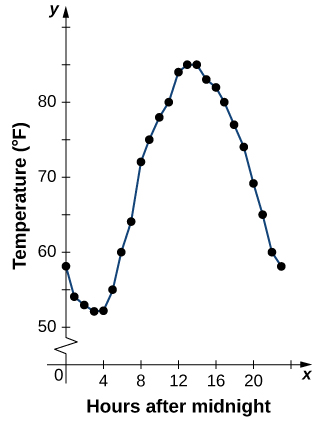
Given a function described by a table, we tin can provide a visual picture of the function in the form of a graph. Graphing the temperatures listed in (Figure) can give us a better idea of their fluctuation throughout the day. (Figure) shows the plot of the temperature part.
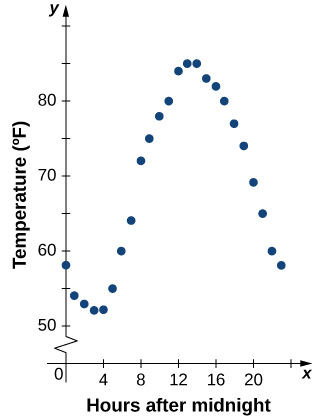
From the points plotted on the graph in (Figure), we can visualize the general shape of the graph. It is often useful to connect the dots in the graph, which represent the data from the tabular array. In this instance, although we cannot make any definitive conclusion regarding what the temperature was at whatever fourth dimension for which the temperature was non recorded, given the number of information points collected and the pattern in these points, it is reasonable to suspect that the temperatures at other times followed a similar blueprint, as we tin can see in (Figure).
Algebraic Formulas
Sometimes we are not given the values of a function in table form, rather we are given the values in an explicit formula. Formulas arise in many applications. For instance, the area of a circle of radius  is given past the formula
  . When an object is thrown upward from the footing with an initial velocity
  ft/s, its top to a higher place the ground from the fourth dimension it is thrown until it hits the ground is given past the formula
  . When
  dollars are invested in an account at an annual involvement rate compounded continuously, the amount of money after
  years is given by the formula
  . Algebraic formulas are important tools to calculate part values. Often we likewise represent these functions visually in graph form.
Given an algebraic formula for a part , the graph of is the gear up of points  , where is in the domain of and is in the range. To graph a function given past a formula, it is helpful to begin by using the formula to create a table of inputs and outputs. If the domain of consists of an infinite number of values, nosotros cannot listing all of them, simply because listing some of the inputs and outputs tin can exist very useful, it is often a skilful way to begin.
When creating a table of inputs and outputs, nosotros typically check to decide whether zero is an output. Those values of where  are chosen the zeros of a function. For instance, the zeros of
  are
are  . The zeros decide where the graph of intersects the -axis, which gives usa more data most the shape of the graph of the role. The graph of a function may never intersect the -axis, or it may intersect multiple (or even infinitely many) times.
Another point of interest is the -intercept, if information technology exists. The -intercept is given past  .
.
Since a function has exactly 1 output for each input, the graph of a function tin have, at most, one -intercept. If  is in the domain of a office , then has exactly 1 -intercept. If is not in the domain of , then has no -intercept. Similarly, for whatsoever real number
  , if is in the domain of , at that place is exactly one output
  , and the line
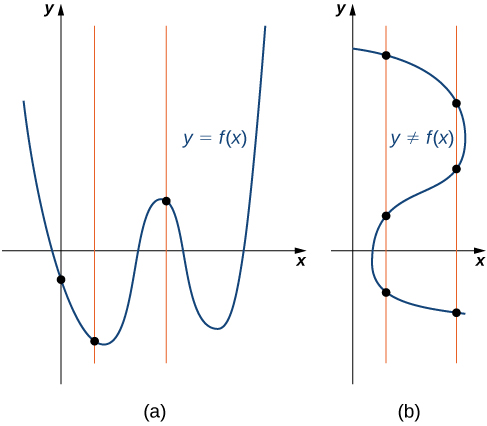
  intersects the graph of exactly in one case. On the other mitt, if is not in the domain of , is not defined and the line does not intersect the graph of . This property is summarized in the vertical line examination.
Rule: Vertical Line Test
Given a function , every vertical line that may be drawn intersects the graph of no more than than in one case. If any vertical line intersects a set of points more than in one case, the ready of points does not stand for a role.
We can utilise this test to determine whether a set of plotted points represents the graph of a role ((Effigy)).
Finding Zeros and -Intercepts of a Role
Using Zeros and -Intercepts to Sketch a Graph
Discover the zeros of  .
.
Solution

Finding the Height of a Free-Falling Object
Note that for this function and the function  graphed in (Figure), the values of are getting smaller as is getting larger. A office with this property is said to be decreasing. On the other hand, for the function
  graphed in (Figure), the values of are getting larger as the values of are getting larger. A role with this belongings is said to be increasing. It is important to notation, still, that a office can be increasing on some interval or intervals and decreasing over a dissimilar interval or intervals. For example, using our temperature function in (Figure), we tin encounter that the function is decreasing on the interval
  , increasing on the interval
  , so decreasing on the interval
  . We brand the idea of a function increasing or decreasing over a particular interval more precise in the next definition.
Definition
We say that a function is increasing on the interval  if for all
  ,
,
 .
.
We say is strictly increasing on the interval if for all  ,
,
 .
.
We say that a function is decreasing on the interval if for all ,
 .
.
We say that a function is strictly decreasing on the interval if for all  ,
,
 .
.
For instance, the function  is increasing on the interval because
  whenever
  . On the other manus, the part
  is decreasing on the interval considering
  whenever
  ((Effigy)).
Combining Functions
Now that we have reviewed the bones characteristics of functions, we can see what happens to these properties when we combine functions in different ways, using basic mathematical operations to create new functions. For example, if the cost for a company to manufacture items is described by the function  and the revenue created by the sale of items is described by the function
  , and so the turn a profit on the manufacture and auction of items is defined as
  . Using the departure betwixt two functions, we created a new role.
Alternatively, we can create a new role by composing ii functions. For example, given the functions and  , the composite function
  is defined such that
 .
.
The composite part  is defined such that
 .
.
Note that these ii new functions are different from each other.
Combining Functions with Mathematical Operators
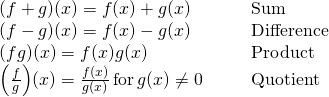
To combine functions using mathematical operators, we simply write the functions with the operator and simplify. Given two functions and  we can define four new functions:
Combining Functions Using Mathematical Operations
Function Composition
When we etch functions, nosotros take a function of a function. For example, suppose the temperature  on a given day is described as a function of time (measured in hours later on midnight) as in (Figure). Suppose the toll
  , to estrus or cool a building for one hour, can be described as a function of the temperature . Combining these two functions, we tin depict the cost of heating or cooling a edifice as a function of time past evaluating
  . We have defined a new function, denoted
  , which is defined such that
  for all in the domain of . This new function is called a composite part. We note that since cost is a function of temperature and temperature is a part of time, information technology makes sense to define this new function
  . Information technology does non make sense to consider
  , because temperature is not a function of toll.
A composite function can be viewed in two steps. First, the function maps each input in the domain of to its output in the range of . Second, since the range of is a subset of the domain of  , the output is an chemical element in the domain of , and therefore it is mapped to an output
  in the range of . In (Figure), we see a visual paradigm of a blended office.
Compositions of Functions Defined by Formulas
Solution
- We can discover the formula for
 in two different means. Nosotros could write
  .
.Alternatively, we could write
 .
.Since
 for all real numbers , the domain of is the set up of all real numbers. Since
  , the range is, at nearly, the interval
 ![(0,1]](https://opentextbc.ca/calculusv1openstax/wp-content/ql-cache/quicklatex.com-d9dde1dfd51c433bbb2e2f93efa18812_l3.png "Rendered by QuickLaTeX.com") . To testify that the range is this entire interval, nosotros allow
. To testify that the range is this entire interval, nosotros allow  and solve this equation for to show that for all in the interval , in that location exists a real number such that . Solving this equation for , nosotros see that
  , which implies that
 .
.If
is in the interval , the expression under the radical is nonnegative, and therefore at that place exists a existent number such that  . We conclude that the range of is the interval .
 -


- We can find a formula for
 in two ways. First, we could write
  .
.Alternatively, nosotros could write
 .
.The domain of
is the set of all real numbers such that  . To observe the range of , we need to discover all values for which there exists a real number such that
 .
.Solving this equation for
, we see that we demand to satisfy ,
,which simplifies to
 .
.Finally, we obtain
 .
.Since
 is a existent number if and merely if
  , the range of is the set
  .
. -


In (Figure), nosotros tin see that  . This tells us, in general terms, that the gild in which we compose functions matters.
Permit  Permit
  Discover .
Solution
 .
.
Composition of Functions Divers by Tables
Application Involving a Composite Function
If items are on sale for  off their original price, and a client has a coupon for an additional
  off, what volition be the final price for an detail that is originally dollars, after applying the coupon to the sale price?
Solution

Symmetry of Functions
The graphs of certain functions take symmetry backdrop that aid us sympathize the function and the shape of its graph. For case, consider the role  shown in (Figure)(a). If nosotros accept the part of the curve that lies to the right of the -axis and flip it over the -axis, it lays exactly on acme of the curve to the left of the -axis. In this instance, we say the function has symmetry about the -axis. On the other mitt, consider the part
  shown in (Figure)(b). If we take the graph and rotate information technology 180° about the origin, the new graph will look exactly the same. In this case, we say the office has symmetry most the origin.
If nosotros are given the graph of a function, it is easy to come across whether the graph has one of these symmetry properties. But without a graph, how can we determine algebraically whether a function has symmetry? Looking at (Figure) again, we come across that since is symmetric near the -axis, if the point is on the graph, the betoken  is on the graph. In other words,
  . If a part has this property, we say is an even office, which has symmetry most the -centrality. For example, is fifty-fifty considering
 .
.
In contrast, looking at (Figure) once again, if a function is symmetric about the origin, then whenever the point is on the graph, the signal  is too on the graph. In other words,
  . If has this property, we say is an odd function, which has symmetry about the origin. For example,
  is odd considering
 .
.
Even and Odd Functions
Make up one's mind whether  is even, odd, or neither.
Solution
is odd.
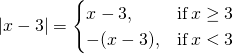
1 symmetric function that arises frequently is the absolute value function, written as  . The absolute value function is divers as

Some students describe this function by stating that information technology "makes everything positive." By the definition of the accented value function, we run into that if  , then
  , and if
  , then
  . However, for
  . Therefore, it is more accurate to say that for all nonzero inputs, the output is positive, but if , the output
  . We conclude that the range of the accented value role is
  . In (Figure), we see that the absolute value function is symmetric near the -centrality and is therefore an even function.
Working with the Accented Value Role
Find the domain and range of the office  .
.
Solution
Since the absolute value office is defined for all real numbers, the domain of this part is  . Since
  for all , the office
  . Therefore, the range is, at about, the set
  . To see that the range is, in fact, this whole set, nosotros demand to show that for
  there exists a real number such that
 .
.
A real number satisfies this equation every bit long every bit
 .
.
Since , we know  , and thus the right-hand side of the equation is nonnegative, so it is possible that there is a solution. Furthermore,
 .
.
Therefore, nosotros come across at that place are two solutions:
 .
.
The range of this function is .
For the function  , find the domain and range.
Solution
Domain = , range =  .
.
Key Concepts
Cardinal Equations
For the following exercises, (a) decide the domain and the range of each relation, and (b) country whether the relation is a office.
Solution
a. Domain =  , range =
  b. Yes, a function
Solution
a. Domain =  , range = b. No, not a role
Solution
a. Domain =  , range = b. Yes, a part
For the post-obit exercises, discover the values for each function, if they exist, then simplify.
a.  b.
b.  c.
c.  d.
d.  e.
e.  f.
f. 
7. 
8. 
nine. 
10. 
11. 
12. 
13. 
Solution
a. ix b. 9 c. 9 d. ix e. nine f. 9
For the post-obit exercises, find the domain, range, and all zeros/intercepts, if any, of the functions.
xiv. 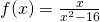
15. 
16. 
17. 
18. 
19. 
20. 
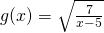
21. 
Solution
Domain:  ; Range:
  ; no intercepts
For the post-obit exercises, set upwards a table to sketch the graph of each office using the following values:  .
.
Solution
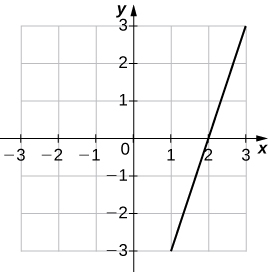
Solution
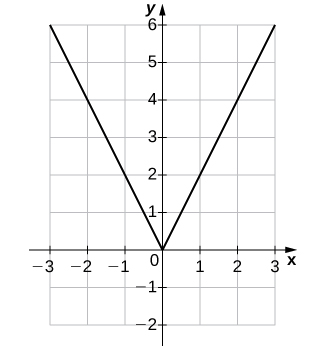
Solution
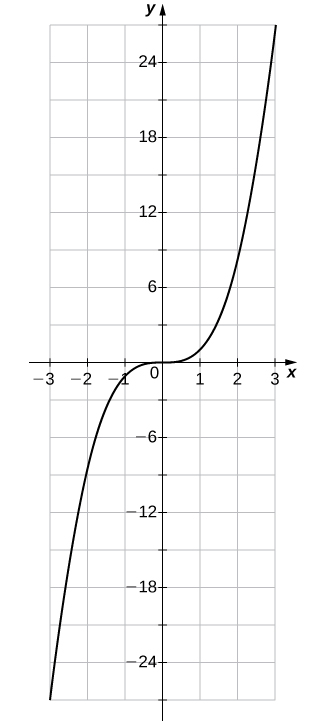
For the following exercises, use the vertical line test to determine whether each of the given graphs represents a function. Assume that a graph continues at both ends if information technology extends beyond the given grid. If the graph represents a function, then determine the following for each graph:
- Domain and range
- -intercept, if any (gauge where necessary)
- -Intercept, if any (guess where necessary)
- The intervals for which the part is increasing
- The intervals for which the office is decreasing
- The intervals for which the function is constant
- Symmetry about any centrality and/or the origin
- Whether the function is even, odd, or neither
28.
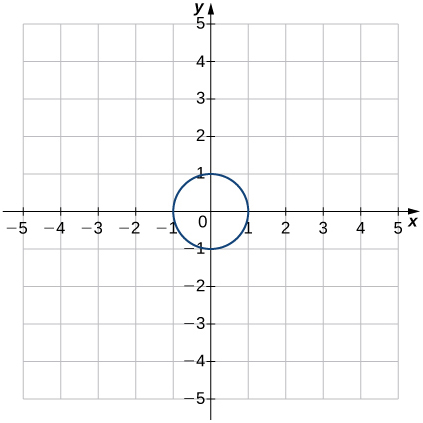
29.
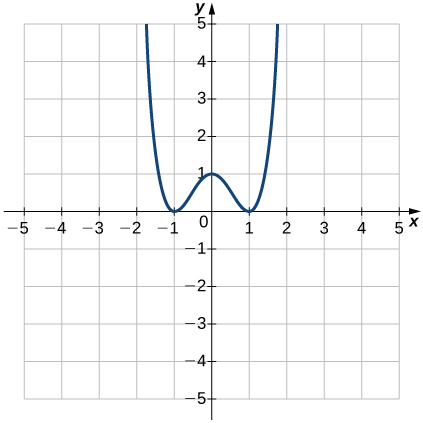
thirty.
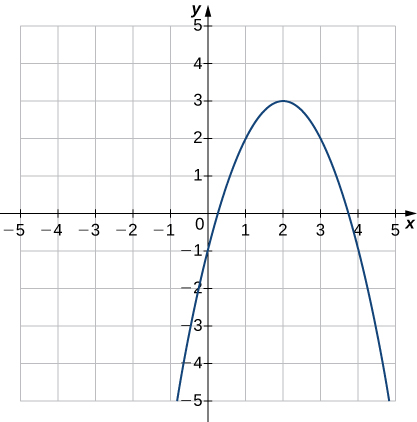
31.
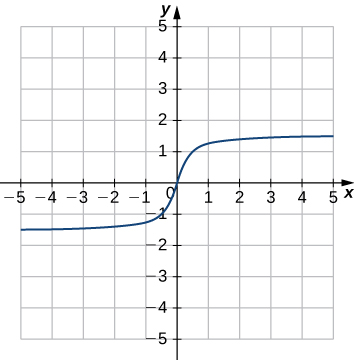
32.
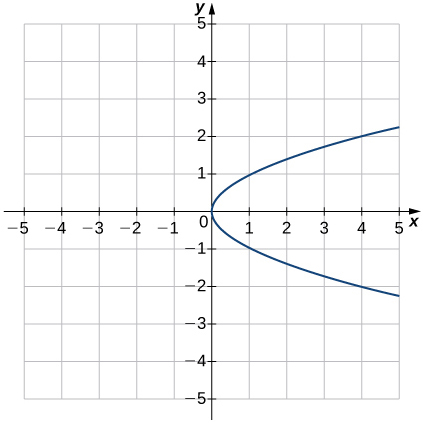
33.
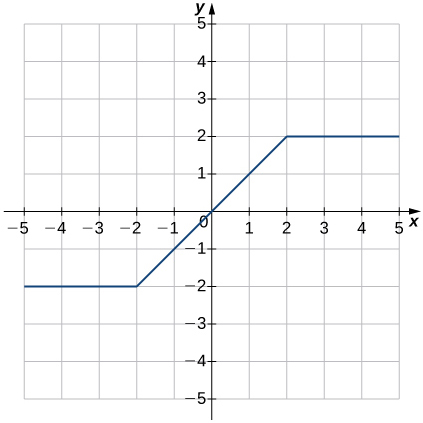
34.
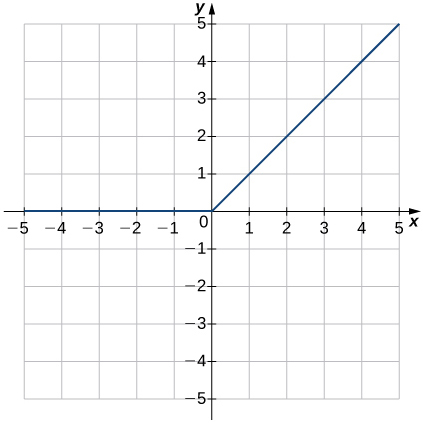
35.
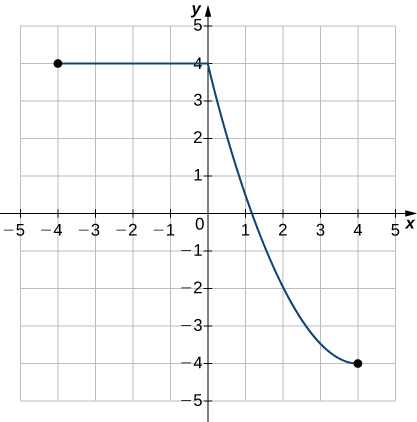
For the post-obit exercises, for each pair of functions, find a.  b.
b.  c.
c.  d.
d.  . Make up one's mind the domain of each of these new functions.
36. 
37. 
38. 
39. 
forty. 
41. 
For the following exercises, for each pair of functions, find a. and b. Simplify the results. Find the domain of each of the results.
42. 
43. 
Solution
a.  ; all real numbers b.
  ; all real numbers
44. 
45. 
Solution
a.  ; all real numbers b.
  ; all real numbers
46. 
48. 
49.The table beneath lists the NBA championship winners for the years 2001 to 2012.
| Yr | Winner |
|---|---|
| 2001 | LA Lakers |
| 2002 | LA Lakers |
| 2003 | San Antonio Spurs |
| 2004 | Detroit Pistons |
| 2005 | San Antonio Spurs |
| 2006 | Miami Heat |
| 2007 | San Antonio Spurs |
| 2008 | Boston Celtics |
| 2009 | LA Lakers |
| 2010 | LA Lakers |
| 2011 | Dallas Mavericks |
| 2012 | Miami Oestrus |
- Consider the relation in which the domain values are the years 2001 to 2012 and the range is the respective winner. Is this relation a function? Explicate why or why non.
- Consider the relation where the domain values are the winners and the range is the corresponding years. Is this relation a office? Explain why or why not.
Solution
a. Yes, considering at that place is but ane winner for each twelvemonth. b. No, because at that place are iii teams that won more than once during the years 2001 to 2012.
Solution
a.  b.
b.  ; a cube of side length 11.viii each has a volume of approximately 1643 cubic units.
52. [T] A rental motorcar company rents cars for a flat fee of $20 and an hourly charge of $10.25. Therefore, the total cost to rent a car is a function of the hours the machine is rented plus the flat fee.
- Write the formula for the part that models this situation.
- Find the total cost to rent a car for 2 days and 7 hours.
- Determine how long the automobile was rented if the pecker is $432.73.
53. [T] A vehicle has a 20-gal tank and gets 15 mpg. The number of miles  that can exist driven depends on the corporeality of gas in the tank.
- Write a formula that models this situation.
- Determine the number of miles the vehicle can travel on (i) a full tank of gas and (ii) three/4 of a tank of gas.
- Determine the domain and range of the part.
- Make up one's mind how many times the driver had to end for gas if she has driven a total of 578 mi.
55. [T] A certain bacterium grows in civilization in a circular region. The radius of the circle, measured in centimeters, is given by ![r(t)=6-[5/(t^2+1)]](https://opentextbc.ca/calculusv1openstax/wp-content/ql-cache/quicklatex.com-1753028d1cf1a54c6017fefca1ebf78c_l3.png "Rendered by QuickLaTeX.com") , where is time measured in hours since a circle of a ane cm radius of the bacterium was put into the culture.
, where is time measured in hours since a circle of a ane cm radius of the bacterium was put into the culture.
- Express the area of the bacteria as a function of time.
- Find the exact and approximate surface area of the bacterial culture in iii hours.
- Express the circumference of the bacteria as a part of time.
- Discover the exact and guess circumference of the bacteria in 3 hours.
Solution
a.  b. $962.50, $1090, $1217.50 c. 77 skateboards
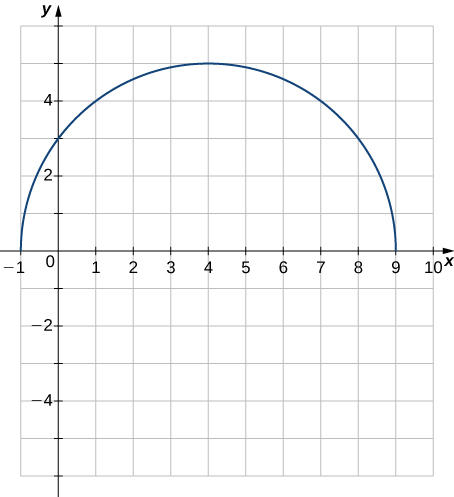
58. [T] Use a graphing estimator to graph the half-circle  . Then, use the INTERCEPT characteristic to find the value of both the – and -intercepts.
Glossary
- absolute value function
-

- composite office
- given two functions and , a new role, denoted , such that

- decreasing on the interval
- a function decreasing on the interval if, for all
 if
if
- dependent variable
- the output variable for a part
- domain
- the prepare of inputs for a function
- even function
- a office is even if for all in the domain of
- role
- a ready of inputs, a ready of outputs, and a rule for mapping each input to exactly one output
- graph of a function
- the set of points such that is in the domain of and
- increasing on the interval
- a function increasing on the interval if for all
 if
if
- independent variable
- the input variable for a function
- odd office
- a function is odd if for all in the domain of
- range
- the prepare of outputs for a function
- symmetry almost the origin
- the graph of a function is symmetric nigh the origin if is on the graph of whenever is on the graph
- symmetry nearly the -axis
- the graph of a function is symmetric about the -axis if is on the graph of whenever is on the graph
- tabular array of values
- a table containing a list of inputs and their corresponding outputs
- vertical line exam
- given the graph of a function, every vertical line intersects the graph, at well-nigh, in one case
- zeros of a role
- when a existent number is a zero of a part ,
Source: https://opentextbc.ca/calculusv1openstax/chapter/review-of-functions/
0 Response to "Calculus Review for Test Sections 2-1 to 2-4"
Enregistrer un commentaire