What Was the Primary Way of Expressing Art During the Stone Age?

In the history of art, prehistoric fine art is all art produced in preliterate, prehistorical cultures outset somewhere in very tardily geological history, and mostly standing until that culture either develops writing or other methods of record-keeping, or makes significant contact with another culture that has, and that makes some record of major historical events. At this indicate ancient art begins, for the older literate cultures. The cease-date for what is covered by the term thus varies profoundly between different parts of the earth.[1]
The primeval human artifacts showing evidence of workmanship with an artistic purpose are the subject of some debate. It is clear that such workmanship existed by 40,000 years ago in the Upper Paleolithic era, although it is quite possible that information technology began earlier. In September 2018, scientists reported the discovery of the earliest known drawing past Human sapiens, which is estimated to be 73,000 years old, much earlier than the 43,000 years old artifacts understood to be the earliest known modern man drawings constitute previously.[2]
Engraved shells created by Human erectus dating every bit far dorsum as 500,000 years ago have been found, although experts disagree on whether these engravings can be properly classified as 'art'.[iii] From the Upper Paleolithic through to the Mesolithic, cave paintings and portable art such as figurines and chaplet predominated, with decorative figured workings likewise seen on some utilitarian objects. In the Neolithic evidence of early pottery appeared, every bit did sculpture and the construction of megaliths. Early on stone art also first appeared during this menstruation. The advent of metalworking in the Statuary Age brought additional media bachelor for utilize in making art, an increment in stylistic diverseness, and the creation of objects that did non accept whatsoever obvious function other than fine art. It as well saw the development in some areas of artisans, a form of people specializing in the production of art, as well as early writing systems. Past the Iron Historic period, civilizations with writing had arisen from Ancient Egypt to Aboriginal China.
Many indigenous peoples from around the world continued to produce artistic works distinctive to their geographic surface area and culture, until exploration and commerce brought tape-keeping methods to them. Some cultures, notably the Maya civilisation, independently adult writing during the time they flourished, which was and then later lost. These cultures may be classified as prehistoric, especially if their writing systems take not been deciphered.
Paleolithic era [edit]
Lower and Middle Paleolithic [edit]


The earliest undisputed art originated with the Man sapiens Aurignacian archaeological culture in the Upper Paleolithic. Yet, there is some evidence that the preference for the aesthetic emerged in the Middle Paleolithic, from 100,000 to 50,000 years ago. Some archaeologists have interpreted certain Eye Paleolithic artifacts as early examples of artistic expression.[5] [6] The symmetry of artifacts, evidence of attention to the detail of tool shape, has led some investigators to excogitate of Acheulean paw axes and especially laurel points as having been produced with a caste of artistic expression.

Claimed "Oldest known drawing by man easily", discovered in Blombos Cavern in Due south Africa. Estimated to exist 73,000 years former.[2]
Similarly, a zigzag engraving supposedly made with a shark tooth on a freshwater Pseudodon trounce DUB1006-fL around 500,000 years ago (i.due east. well into the Lower Paleolithic), associated with Man erectus, could be the earliest evidence of artistic activity, merely the actual intent behind this geometric decoration is non known.[4]
In that location are other claims of Middle Paleolithic sculpture, dubbed the "Venus of Tan-Tan" (earlier 300 kya)[7] and the "Venus of Berekhat Ram" (250 kya). In 2002 in Blombos cave, situated in South Africa, stones were discovered engraved with grid or cross-hatch patterns, dated to some lxx,000 years ago. This suggested to some researchers that early Homo sapiens were capable of abstraction and production of abstract fine art or symbolic fine art. Several archaeologists including Richard Klein are hesitant to accept the Blombos caves every bit the first example of actual art.
In September 2018 the discovery in Southward Africa of the earliest known drawing by Man sapiens was announced, which is estimated to exist 73,000 years old, much earlier than the 43,000 years former artifacts understood to be the earliest known mod human drawings constitute previously.[2] The drawing shows a crosshatched pattern made upwards of ix fine lines. The sudden termination of all of the lines on the fragment edges betoken that the pattern originally extended over a larger surface.[eight] It is besides estimated that the pattern was most likely more circuitous and structured in its entirety than shown on the discovered area. Initially, when this drawing was found, in that location was much debate. To show that this drawing was created past Man Sapiens, French team members who specialized in chemic assay of pigments, reproduced the same lines using a multifariousness of techniques.[ix] They concluded that the lines making up the drawing were intentional and were most likely made with ocher. This discovery adds further dimensions to agreement the behavior and knowledge of early homo sapiens.
Neanderthals may have made fine art. Painted designs in the caves of La Pasiega (Cantabria), a paw stencil in Maltravieso (Extremadura), and ruby-red-painted speleothems in Ardales (Andalusia) are dated to 64,800 years ago, predating by at least xx,000 years the arrival of modern humans in Europe.[10] [11] In July 2021, scientists reported the discovery of a bone carving, i of the world's oldest works of art, fabricated by Neanderthals nearly 51,000 years ago.[12] [13]
Upper Paleolithic [edit]
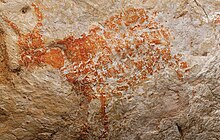
In Nov 2018, scientists reported the discovery of the oldest known figurative art painting, over twoscore,000 (perhaps as onetime as 52,000) years old, of an unknown creature, in the cave of Lubang Jeriji Saléh on the Indonesian isle of Borneo.[14] [15]
Some of the oldest undisputed works of figurative art were found in the Schwäbische Alb, Baden-Württemberg, Germany. The earliest of these, the Venus figurine known as the Venus of Hohle Fels and the Lion-man figurine, date to some 40,000 years ago.
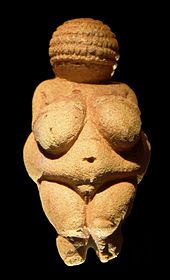
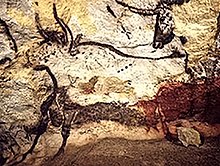
Farther depictional art from the Upper Palaeolithic period (broadly twoscore,000 to 10,000 years ago) includes cave painting (e.grand., those at Chauvet, Altamira, Pech Merle, Arcy-sur-Cure and Lascaux) and portable art: Venus figurines like the Venus of Willendorf, as well as brute carvings similar the Swimming Reindeer, Wolverine pendant of Les Eyzies, and several of the objects known as bâtons de commandement.
Paintings in Pettakere cavern on the Indonesian island of Sulawesi are upwards to 40,000 years one-time, a similar date to the oldest European cave fine art, which may propose an older common origin for this blazon of art, perhaps in Africa.[16]
Awe-inspiring open-air art in Europe from this period includes the rock-art at Côa Valley and Mazouco in Portugal, Domingo García and Siega Verde in Kingdom of spain, and Rocher gravé de Fornols in France.
A cavern at Turobong in Due south Korea containing human remains has been plant to incorporate carved deer bones and depictions of deer that may exist every bit much equally 40,000 years onetime.[17] Petroglyphs of deer or reindeer found at Sokchang-ri may also date to the Upper Paleolithic. Potsherds in a mode reminiscent of early Japanese piece of work have been found at Kosan-ri on Jeju island, which, due to lower sea levels at the time, would have been accessible from Japan.[18]
The oldest petroglyphs are dated to approximately the Mesolithic and belatedly Upper Paleolithic boundary, most 10,000 to 12,000 years ago. The earliest undisputed African rock art dates dorsum about ten,000 years. The beginning naturalistic paintings of humans constitute in Africa engagement back about 8,000 years apparently originating in the Nile River valley, spread as far west equally Mali about 10,000 years ago. Noted sites containing early art include Tassili n'Ajjer in southern People's democratic republic of algeria, Tadrart Acacus in Libya (A Unesco Globe Heritage site), and the Tibesti Mountains in northern Chad.[xix] Rock carvings at the Wonderwerk Cave in S Africa have been dated to this age.[20] Contentious dates every bit far back every bit 29,000 years have been obtained at a site in Tanzania. A site at the Apollo xi Cave complex in Namibia has been dated to 27,000 years.
Göbekli Tepe in Turkey has circles of massive T-shaped rock pillars dating back to the 10th–8th millennium BCE; the globe'southward oldest known megaliths. Many of the pillars are decorated with abstract, enigmatic pictograms and carved animal reliefs.
Asia [edit]

Asia was the cradle for several significant civilizations, virtually notably those of China and Southern asia. The prehistory of eastern asia is especially interesting, every bit the relatively early on introduction of writing and historical record-keeping in Communist china has a notable touch on the immediately surrounding cultures and geographic areas. Little of the very rich traditions of the art of Mesopotamia counts as prehistoric, equally writing was introduced so early on there, but neighbouring cultures such as Urartu, Luristan and Persia had significant and complex artistic traditions.

A possible representation of a "yogi" or "proto-Shiva", 2600–1900 BCE
Azerbaijan [edit]
The Gobustan National Park reserve located at the southward-e of the Greater Caucasus Mountains in Azerbaijan, 60 km abroad from Baku date back more than 12 thousand years ago. The reserve has more six,000 rock carvings depicting more often than not hunting scenes, human and brute figures. There are also longship illustrations similar to Viking ships. Gobustan is also characterized past its natural musical rock called Gavaldash (tambourine stone).[21] [22] [23] [24] [25] [ cocky-published source? ]
Indian sub-continent [edit]
The primeval Indian paintings were the rock paintings of prehistoric times, the petroglyphs as institute in places like the Stone Shelters of Bhimbetka, and some of them are dated to circa 8,000 BC.[26] [27] [28] [29] [30] The Indus Valley civilisation produced fine small-scale stamp seals and sculptures, and may have been literate, only after its plummet there are relatively few artistic remains until the literate menstruation, probably as perishable materials were used.
China [edit]

Prehistoric artwork such as painted pottery in Neolithic China tin can exist traced back to the Yangshao civilization and Longshan civilization of the Yellow River valley. During Communist china'due south Statuary Age, Chinese of the ancient Shang Dynasty and Zhou Dynasty produced multitudes of Chinese ritual bronzes, which are elaborate versions of ordinary vessels and other objects used in rituals of antecedent veneration, busy with taotie motifs and past the tardily Shang Chinese statuary inscriptions. Discoveries in 1987 in Sanxingdui in central China revealed a previously unknown pre-literate Bronze Historic period culture whose artefacts included spectacular very large statuary figures (instance left), and which appeared culturally very dissimilar from the contemporary belatedly Shang, which has e'er formed part of the account of the continuous tradition of Chinese culture.
Japan [edit]

According to archeological show, the Jōmon people in ancient Nihon were among the first to develop pottery, dated from the 11th millennium BCE. With growing sophistication, the Jōmon created patterns by impressing the moisture clay with braided or unbraided cord and sticks.
Korea [edit]

A Korean Neolithic pot found in Busan, 3500 BCE
The earliest examples of Korean fine art consist of Stone Age works dating from 3000 BCE. These mainly consist of votive sculptures, although petroglyphs accept also been recently rediscovered. Rock arts, elaborate stone tools, and potteries were also prevalent.
This early period was followed by the art styles of various Korean kingdoms and dynasties. In these periods, artists often adopted Chinese style in their artworks. However, Koreans not only adopted but also modified Chinese culture with a native preference for uncomplicated elegance, purity of nature and spontaneity. This filtering of Chinese styles afterwards influenced Japanese artistic traditions, due to cultural and geographical circumstances.
The prehistory of Korean ends with the founding of the Three Kingdoms of Korea, which are documented in the Samguk Sagi, a 12th-century CE text written in Classical Chinese (the written language of the literati in traditional Korea), as outset in the 1st century BCE; some mention of earlier history is as well made in Chinese texts, like the 3rd-century CE Sanguo Zhi.
Jeulmun period [edit]
Clearer evidence of culture emerges in the tardily Neolithic, known in Korea as the Jeulmun pottery period, with pottery similar to that found in the adjacent regions of China, decorated with Z-shaped patterns. The primeval Neolithic sites with pottery remains, for instance Osan-ri, date to 6000–4500 BCE.[xviii] This pottery is characterized by comb patterning, with the pot frequently having a pointed base. Ornaments from this time include masks fabricated of shell, with notable finds at Tongsam-dong, Osan-ri, and Sinam-ri. Hand-shaped clay figurines take been found at Nongpo-dong.[31]
Mumun period [edit]

Large Middle Mumun (c. 800 BCE) storage vessel unearthed from a pit-business firm in or most Daepyeong
During the Mumun pottery menstruum, roughly betwixt 1500 BCE and 300 BCE, agriculture expanded, and testify of larger-scale political structures became apparent, every bit villages grew and some burials became more elaborate. Megalithic tombs and dolmens throughout Korea engagement to this time. The pottery of the fourth dimension is in a distinctive undecorated style. Many of these changes in style may take occurred due to immigration of new peoples from the north, although this is a subject of debate.[32] At a number of sites in southern Korea there are rock fine art panels that are thought to engagement from this menstruation, mainly for stylistic reasons.[33]
While the verbal date of the introduction of bronzework into Korea is also a matter of contend, information technology is clear that statuary was existence worked by almost 700 BCE. Finds include stylistically distinctive daggers, mirrors, and belt buckles, with prove by the 1st century BCE of a widespread, locally distinctive, bronzeworking culture.[34]
Protohistoric Korea [edit]

The fourth dimension between 300 BCE and the founding and stabilization of the 3 Kingdoms around 300 CE is characterized artistically and archaeologically by increasing trade with Communist china and Japan, something that Chinese histories of the time corroborate. The expansionist Chinese invaded and established commanderies in northern Korea equally early as the 1st century BCE; they were driven out by the quaternary century CE.[35] The remains of some of these, especially that of Lelang, well-nigh modernistic Pyongyang, take yielded many artifacts in a typical Han style.[36]
Chinese histories too record the ancestry of fe works in Korea in the 1st century BCE. Stoneware and kiln-fired pottery also appears to date from this time, although there is controversy over the dates.[37] Pottery of distinctly Japanese origin is found in Korea, and metalwork of Korean origin is constitute in northeastern China.[38]
Steppes Art [edit]

Tardily 7th-century Scythian plaque of a leopard
Superb samples of Steppes art - more often than not golden jewellery and trappings for horse - are found over a vast expanses of land stretching from Hungary to Mongolia. Dating from the period between the 7th and third centuries BCE, the objects are usually diminutive, as may be expected from nomadic people always on the move. Fine art of the steppes is primarily an fauna art, i.e., combat scenes involving several animals (real or imaginary) or single animal figures (such as aureate stags) predominate. The best known of the diverse peoples involved are the Scythians, at the European finish of the steppe, who were especially likely to coffin gold items.
Among the most famous finds was made in 1947, when the Soviet archaeologist Sergei Rudenko discovered a imperial burial at Pazyryk, Altay Mountains, which featured - among many other important objects - the most ancient extant pile rug, probably made in Persia. Unusually for prehistoric burials, those in the northern parts of the area may preserve organic materials such as wood and textiles that ordinarily would decay. Steppes people both gave and took influences from neighbouring cultures from Europe to China, and afterwards Scythian pieces are heavily influenced past ancient Greek way, and probably oftentimes made by Greeks in Scythia.
Nigh E [edit]
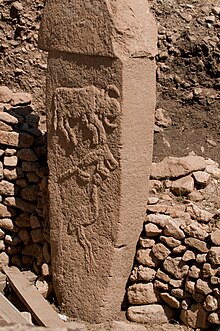
The Ain Sakhri Lovers from mod Israel, is a modest Natufian carving in calcite, from most ix,000 BCE. Around the aforementioned time, the extraordinary site of Göbekli Tepe in eastern Turkey was begun. During the first phase, belonging to the Pre-Pottery Neolithic A (PPNA), circles of massive but neatly shaped T-shaped stone pillars were erected – the world'southward oldest known megaliths.[39] More 200 pillars in almost 20 circles are currently known through geophysical surveys. Each pillar has a tiptop of up to 6 m (20 ft) and weighs upwards to 10 tons. They are fitted into sockets that were hewn out of the bedrock.[forty] In the second phase, belonging to the Pre-Pottery Neolithic B (PPNB), the erected pillars are smaller and stood in rectangular rooms with floors of polished lime. On the smoothed surfaces of the pillars there are reliefs of animals, abstract patterns, and some human figures.
Past convention, prehistory in the Near East is taken to continue until the rise of the Achaemenid Empire in the 6th century BCE, although writing existed in the region from nearly ii,000 years before. On that ground the very rich and long tradition of the art of Mesopotamia, as well as Assyrian sculpture, Hittite art and many other traditions such equally the Luristan bronzes all fall under prehistoric art, fifty-fifty if covered with texts extolling the ruler, as many Assyrian palace reliefs are.
Europe [edit]
Stone Age [edit]
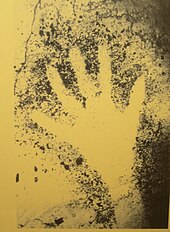
The Art of the Upper Paleolithic includes carvings on antler and bone, especially of animals, as well equally the so-chosen Venus figurines and cave paintings, discussed above. Despite a warmer climate, the Mesolithic flow undoubtedly shows a falling-off from the heights of the preceding period. Stone art is found in Scandinavia and northern Russia, and around the Mediterranean in eastern Spain and the earliest of the Rock Drawings in Valcamonica in northern Italia, simply non in between these areas.[41] [42] Examples of portable fine art include painted pebbles from the Azilian culture which succeeded the Magdalenian, and patterns on utilitarian objects, like the paddles from Tybrind Vig, Kingdom of denmark. The Mesolithic statues of Lepenski Vir at the Atomic number 26 Gate, Serbia date to the seventh millennium BCE and represent either humans or mixtures of humans and fish. Simple pottery began to develop in various places, fifty-fifty in the absenteeism of farming.
Mesolithic [edit]
Compared to the preceding Upper Paleolithic and the following Neolithic, at that place is rather less surviving art from the Mesolithic. The Rock art of the Iberian Mediterranean Basin, which probably spreads across from the Upper Paleolithic, is a widespread miracle, much less well known than the cave-paintings of the Upper Paleolithic, with which it makes an interesting dissimilarity. The sites are now more often than not cliff faces in the open up air, and the subjects are at present mostly human rather than animate being, with large groups of small figures; there are 45 figures at Roca dels Moros. Clothing is shown, and scenes of dancing, fighting, hunting and food-gathering. The figures are much smaller than the animals of Paleolithic art, and depicted much more than schematically, though often in energetic poses.[43] A few minor engraved pendants with pause holes and simple engraved designs are known, some from northern Europe in amber, and i from Starr Carr in United kingdom in shale.[44]
The rock art in the Urals appears to bear witness similar changes after the Paleolithic, and the wooden Shigir Idol is a rare survival of what may well have been a very mutual textile for sculpture. It is a plank of larch carved with geometric motifs, but topped with a human head. At present in fragments, it would manifestly have been over five metres tall when fabricated.[45]
Neolithic [edit]
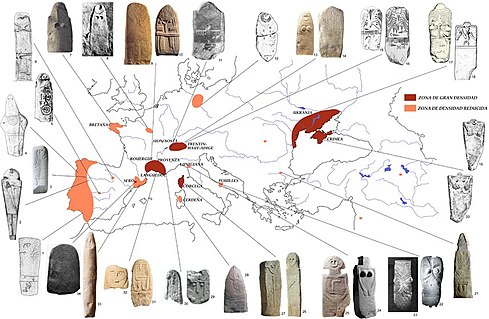
Map with distribution of statue-menhir in Europe.[1] Photos and pictures: 1y 4.-Bueno et al. 2005; 2.-Santonja y Santonja 1978; three.-Jorge 1999; 5.-Portela y Jiménez 1996; 6.-Romero 1981; seven.-Helgouach 1997; 8.- Tarrete 1997; 9, ten, xiii, xiv, 29, 30, 31, 32.-Philippon 2002; 11.-Corboud y Curdy 2009; 12.-Muller 1997; xv, 16, 17, xviii, nineteen, 20, 21, 22, 23 Arnal 1976; 24 y 25.- Augusto 1972; 26 y 27.- Grosjean 1966; 34.- López et al. 2009.
In Key Europe, many Neolithic cultures, like Linearbandkeramic, Lengyel and Vinča,[46] produced female (rarely male person) and animal statues that can be called fine art, and elaborate pottery decoration in, for example, the Želiesovce and painted Lengyel way.
Megalithic (i.e., large stone) monuments are found in the Neolithic Era from Malta to Portugal, through France, and across southern England to most of Wales and Republic of ireland. They are also plant in northern Federal republic of germany and Poland, equally well as in Egypt in the Sahara desert (at Nabta Playa and other sites). The all-time preserved of all temples and the oldest free standing structures are the Megalithic Temples of Malta. They first in the 5th millennium BC, though some authors speculate on Mesolithic roots. One of the best-known prehistoric sites is Stonehenge, office of the Stonehenge World Heritage Site which contains hundreds of monuments and archaeological sites. Monuments have been found throughout most of Western and Northern Europe, notably at Carnac, France.

Entrance stone with megalithic art at Newgrange
The large mound tomb at Newgrange, Republic of ireland, dating to around 3200 BC, has its archway marked with a massive stone carved with a complex design of spirals. The mound at nearby Knowth has large flat rocks with stone engravings on their vertical faces all around its circumference, for which various meanings have been suggested, including depictions of the local valley, and the oldest known image of the Moon. Many of these monuments were megalithic tombs, and archaeologists speculate that virtually have religious significance. Knowth is reputed to accept approximately ane tertiary of all megalithic art in Western Europe.
In the primal Alps, the Camunni made some 350,000 petroglyphs: see Rock Drawings in Valcamonica.
Statuary Age [edit]

During the 3rd millennium BCE, the Bronze Age began in Europe, bringing with it a new medium for art. The increased efficiency of bronze tools also meant an increase in productivity, which led to a surplus — the starting time step in the creation of a class of artisans. Because of the increased wealth of society, luxury goods began to be created, especially busy weapons.
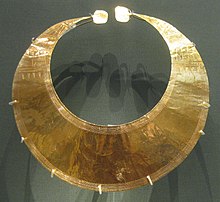
Examples include ceremonial bronze helmets, ornamental ax-heads and swords, elaborate instruments such as lurer, and other formalism objects without a applied purpose, such as the oversize Oxborough Dirk. Special objects were made in gilt; many more gold objects have survived from Western and Central Europe than from the Atomic number 26 Age, many mysterious and strange objects ranging from lunulas, apparently an Irish speciality, the Mold Cape and Gold hats. Pottery from Primal Europe can be elaborately shaped and decorated. Stone art, showing scenes from the religious rituals accept been found in many areas, for example in Bohuslän, Sweden and the Val Camonica in northern Italy.
In the Mediterranean, the Minoan culture was highly developed, with palace complexes from which sections of frescos have been excavated. Gimmicky Ancient Egyptian art and that of other advanced Near Eastern cultures can no longer exist treated as "prehistoric".
Iron Age [edit]
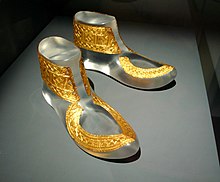
The Iron Age saw the development of anthropomorphic sculptures, such as the warrior of Hirschlanden, and the statue from the Glauberg, Deutschland. Hallstatt artists in the early Fe Historic period favored geometric, abstract designs perchance influenced by trade links with the Classical globe.
The more than elaborate and curvilinear La Tène style adult in Europe in the later Atomic number 26 Historic period from a heart in the Rhine valley but information technology soon spread across the continent. The rich chieftain classes appear to take encouraged ostentation and Classical influences such as bronze drinking vessels attest to a new manner for wine drinking. Communal eating and drinking were an important part of Celtic society and civilization and much of their fine art was often expressed through plates, knives, cauldrons and cups. Horse tack and weaponry were as well decorated. Mythical animals were a common motif along with religious and natural subjects and their depiction is a mix between the naturalistic and the stylized. Megalithic art was withal sometimes proficient, examples include the carved limestone pillars of the sanctuary at Entremont in modern-mean solar day French republic. Personal adornment included torc necklaces whilst the introduction of coinage provided a further opportunity for artistic expression. The coins of this period are derivatives of Greek and Roman types, merely showing the more exuberant Celtic artistic style.
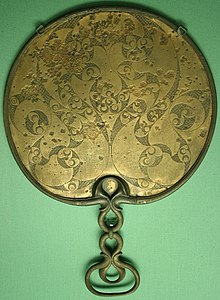
A 1st century BCE mirror found in Desborough, England, showing the spiral and trumpet motif
The famous late quaternary century BCE Waldalgesheim chariot burial in the Rhineland produced many fine examples of La Tène fine art including a statuary flagon and statuary plaques with repoussé human figures. Many pieces had curvy, organic styles though to be derived from Classical tendril patterns.
In much of western Europe elements of this artistic manner can be discerned surviving in the fine art and architecture of the Roman colonies. In particular in U.k. and Ireland there is a tenuous continuity through the Roman menses, enabling Celtic motifs to resurface with new vigour in the Christian Insular art from the sixth century onwards.
The sophisticated Etruscan culture adult from the 9th to 2nd centuries, with considerable influence from the Greeks, before finally being captivated by the Romans. By the finish of the period they had developed writing, but early Etruscan art can be called prehistoric.
Africa [edit]
Ancient Arab republic of egypt falls exterior the scope of this commodity; it had a close relationship with the Sudan in particular, known in this period as Nubia, where there were advanced cultures from the 4th millennium BCE, such as the "A-Group", "C-Group", and the Kingdom of Kush.
Southern Africa [edit]
In September 2018, scientists from the University of Bergen, the University of Bordeaux and the University of the Witwatersrand together reported the discovery of the primeval known cartoon past Homo sapiens at Blombos Cave, S Africa which is estimated to be 73,000 years old, much earlier than the 43,000 years quondam artifacts understood to be the earliest known modern homo drawings found previously.[two]
There is a significant body of rock painting in the region around Matobo National Park of Zimbabwe dating from every bit early every bit 6000 BCE to 500 CE.[47]
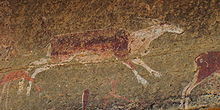
Significant San rock paintings exist in the Waterberg expanse above the Palala River and around Drakensberg in South Africa, some of which are considered to derive from the menstruation 8000 BCE. These images are very clear and depict a variety of human and wild animals motifs, especially antelope. At that place appears to be a fairly continuous history of rock painting in this area; some of the art clearly dates into the 19th century. They include depictions of horses with riders, which were not introduced to the area until the 1820s.[48]
Namibia, in add-on to the Apollo xi Cave circuitous, has a significant array of San rock art almost Twyfelfontein. This piece of work is several chiliad years old, and appears to end with the arrival of pastoral tribes in the area.[49]
Horn of Africa [edit]

Laas Geel is a circuitous of caves and rock shelters in northwestern Somalia. Famous for their rock art, the caves are located in a rural area on the outskirts of Hargeisa. They incorporate some of the primeval known cavern paintings in the Horn of Africa, many of which depict pastoral scenes. Laas Geel's rock art is estimated to appointment back to somewhere betwixt nine,000–eight,000 and iii,000 BCE.
In 2008, archaeologists as well announced the discovery of cave paintings in Somalia'south northern Dhambalin region, which the researchers propose includes one of the earliest known depictions of a hunter on horseback. The rock art is in the Ethiopian-Arabian style, dated to thou to 3000 BCE.[fifty] [51]
Other prehistoric fine art in the Horn region include rock megaliths and engravings, some of which are three,500 years old. The town of Dillo in Ethiopia has a hilltop covered with rock stelae. It is one of several such sites in southern Ethiopia dating from age[ description needed ] (10th-14th centuries).[52]
Saharan Africa [edit]

The early art of this region has been divided into five periods:
- Bubalus Catamenia, roughly 12-8 kya
- Round Head Period, roughly x-8 kya
- Pastoral Period, roughly 7.5-4 kya
- Equus caballus Period, roughly 3-2 kya
- Camel Period, 2,000 years ago to the present
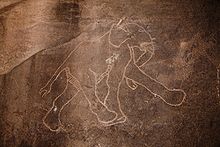
Works of the Bubalus period span the Sahara, with the finest work, carvings of naturalistically depicted megafauna, concentrated in the fundamental highlands. The Round Head Menstruum is dominated past paintings of strangely shaped human forms, and few animals, suggesting the artists were foragers. These works are largely limited to Tassili northward'Ajjer and the Tadrart Acacus. Toward the stop of the menstruum, images of domesticated animals, as well as decorative article of clothing and headdresses appear. Pastoral Menstruum art was more than focused on domestic scenes, including herding and dancing. The quality of artwork declined, as figures became more simplified.[53]
The Horse Period began in the eastern Sahara and spread due west. Depictions from this period include carvings and paintings of horses, chariots, and warriors with metal weapons, although there are also frequent depictions of wild fauna such every bit giraffes. Humans are mostly depicted in a stylized way. Some of the chariot fine art bears resemblance to temple carvings from ancient Arab republic of egypt. Occasionally, art panels are accompanied by Tifinagh script, still in use past the Berber people and the Tuareg today; all the same, modern Tuareg are generally unable to read these inscriptions. The terminal Camel period features carvings and paintings in which camels predominate, merely also include humans with swords, and later, guns; the art of this fourth dimension is relatively crude.[54]
North Africa [edit]
The Americas [edit]
North America [edit]
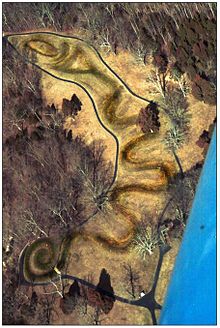
Belonging in the Lithic stage, the oldest known fine art in the Americas is the Vero Beach os, possibly a mammoth bone, etched with a profile of walking mammoth that dates back to 11,000 BCE.[55] The oldest known painted object in the Americas is the Cooper Bison Skull from 10,900 to 10,200 BCE.[56]
Mesoamerica [edit]
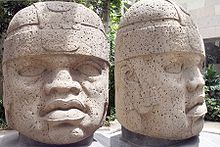
The ancient Olmec "Bird Vessel" and bowl, both ceramic and dating to circa 1000 BC likewise every bit other ceramics were produced in kilns capable of exceeding approximately 900 °C. The only other prehistoric civilization known to have achieved such loftier temperatures is that of Ancient Egypt.[57]
Much Olmec art is highly stylized and uses an iconography cogitating of the religious significant of the artworks. Some Olmec art, however, is surprisingly naturalistic, displaying an accuracy of delineation of human being anatomy perchance equaled in the pre-Columbian New Earth merely by the best Maya Classic-era art. Olmec art-forms emphasize monumental bronze and pocket-size jade carvings. A common theme is to exist constitute in representations of a divine jaguar. Olmec figurines were too plant abundantly through their period.
Due south America [edit]
Lithic age art in Due south America includes Monte Alegre civilization rock paintings created at Caverna da Pedra Pintada dating back to 9250–8550 BCE.[58] [59] Guitarrero Cave in Peru has the earliest known textiles in South America, dating to 8000 BCE.[60]
Peru and the central Andes [edit]
Lithic and preceramic periods [edit]
Republic of peru, including an surface area of the central Andes stretching from the northern part of the country to northern Republic of chile, has a rich cultural history, with evidence of man habitation dating to roughly 10,000 BCE.[61] Prior to the emergence of ceramics in this region around 1850 BCE, cave paintings and beads take been found. These finds include rock paintings that controversially date as far dorsum as 9500 BCE in the Toquepala Caves.[62] Burial sites in Peru like one at Telarmachay as one-time as 8600-7200 BCE independent show of ritual burial, with ruby-red ocher and bead necklaces.[63]
The earliest ceramics that appear in Peru may accept been imported from the Validivia region; ethnic pottery production near certainly arrived in the highlands around 1800 BCE at Kotosh, and on the coast at La Florida c. 1700 BCE. Older calabash gourd vessels with human faces burned into them were found at Huaca Prieta, a site dating to 2500-2000 BCE[64] Huaca Prieta likewise independent some early patterned and dyed textiles fabricated from twisted establish fibers.[65]
Initial Flow and First Horizon [edit]
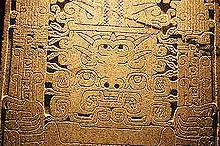
The Initial Period in Central Andean cultures lasted roughly from 1800 BCE to 900 BCE. Textiles from this time found at Huaca Prieta are of astonishing complexity, including images such as crabs whose claws transform into snakes, and double-headed birds. Many of these images are like to optical illusions, where which image dominates depends in role on which the viewer chooses to see. Other portable artwork from this fourth dimension includes decorated mirrors, bone and shell jewelry, and unfired clay female effigies.[66] Public architecture, including works estimated to require the move of more than 100,000 tons of rock, are to be establish at sites like Kotosh, El Paraíso, Peru, and La Galgada (archaeological site). Kotosh, a site in the Andean highlands, is specially noted as the site of the Temple of the Crossed Hands, in which there are two reliefs of crossed forearms, one pair male, one pair female.[67] Also of notation is i of Southward America's largest formalism sites, Sechín Alto. This site's crowning work is a twelve-story platform, with stones incised with military themes.[68] The architecture and art of the highlands, in particular, laid downwardly the background for the rise of the Chavín culture.[69]
The Chavín culture dominated the cardinal Andes during the Get-go Horizon, beginning around 900 BCE, and is by and large divided into two stages. The offset, running until about 500 BCE, represented a significant cultural unification of the highland and coastal cultures of the fourth dimension. Imagery in all mode of art (textiles, ceramics, jewelry, and architectural) included sometimes fantastic imagery such as jaguars, snakes, and man–animal composites, much of it seemingly inspired by the jungles to the east.[70]
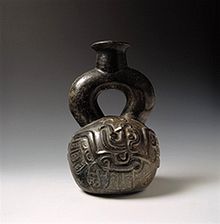
The after stage of the Chavín culture is primarily represented by a pregnant architectural expansion of the Chavín de Huantar site around 500 BCE, accompanied by a set of stylistic changes. This expansion included, among other changes, over forty big stone heads, whose reconstructed positions represent a transformation from human to supernatural animal visages. Much of the other art at the circuitous from this time contains such supernatural imagery.[71] The portable art associated with this fourth dimension included sophisticated metalworking, including alloying of metals and soldering.[72] Textiles constitute at sites similar Karwa clearly depict Chavín cultural influences,[73] and the Cupisnique way of pottery disseminated by the Chavín would ready standards all across the region for later cultures.[74] (The vessel pictured at the top of this article, while from the later on Moche civilisation, is representative of the stirrup-spouted vessels of the Chavín.)
Early Intermediate Flow [edit]
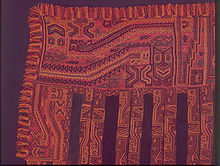
A Paracas Mantle dating from 200 CE
The Early on Intermediate Menstruation lasted from most 200 BCE to 600 CE. Late in the Get-go Horizon, the Chavín culture began to decline, and other cultures, predominantly in the coastal areas, began to develop. The primeval of these was the Paracas culture, centered on the Paracas Peninsula of central Peru. Active from 600 BCE to 175 BCE, their early work clearly shows Chavín influence, simply a locally distinctive style and technique developed. Information technology was characterized by technical and fourth dimension-consuming detail work, visually colorful, and a profusion visual elements. Distinctive technical differences include painting on dirt later firing, and embroidery on textiles.[75] One notable find is a drapery that was clearly used for preparation purposes; it shows obvious indications of experts doing some of the weaving, interspersed with less technically proficient trainee work.[76]

The Nazca culture of southern Peru, which is widely known for the enormous figures traced on the ground past the Nazca lines in southern Peru, shared some similarities with the Paracas culture, simply techniques (and calibration) differed. The Nazca painted their ceramics with skid, and also painted their textiles.[77] Nazca ceramics featured a broad variety of subjects, from the mundane to the fantastic, including utilitarian vessels and effigy figures. The Nazca also excelled at goldsmithing, and made pan pipes from clay in a style non unlike the pipes heard in music of the Andes today.[78]
The famous Nazca lines are accompanied by temple-similar constructions (showing no sign of permanent habitation) and open plazas that presumably had ritual purposes related to the lines. The lines themselves are laid out on a sort of natural blackboard, where a thin layer of dark stone covers lighter rock; the lines were thus created by simply removing the summit layer where desired, after using surveying techniques to lay out the pattern.[79]
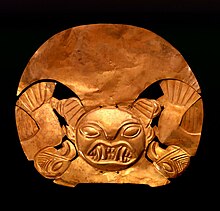
In the north of Peru, the Moche culture dominated during this time. Likewise known equally Mochica or Early Chimú, this warlike civilization dominated the area until almost 500 CE, apparently using conquest to gain admission to critical resources along the desert coast: arable land and h2o. Moche fine art is again notably distinctive, expressive and dynamic in a mode that many other Andean cultures were non. Knowledge of the period has been notably expanded by finds similar the pristine imperial tombs at Sipán.[80]
The Moche very apparently captivated some elements of the Chavín civilization, but also absorbed ideas from smaller nearby cultures that they alloyed, such equally the Recuay culture and the Vicús.[81] They made fully sculpted ceramic animal figures, worked gold, and wove textiles. The art often featured everyday images, but seemingly always with a ritual intent.[82]
In its later years, the Moche came under the influence of the expanding Huari empire. The Cerro Blanco site of Huaca del Sol appears to take been the Moche capital. Largely destroyed by natural events effectually 600 CE, it was farther damaged by Spanish conquistadors searching for golden, and continues with modern looters.[83]
Center Horizon [edit]

Ponce monolith in the sunken courtyard of the Tiwanaku's Kalasasaya temple
The Eye Horizon lasted from 600 CE to thou CE, and was dominated by two cultures: the Huari and the Tiwanaku. The Tiwanaku (also spelled Tiahuanaco) civilisation arose well-nigh Lake Titicaca (on the mod border between Republic of peru and Bolivia), while the Wari civilization arose in the southern highlands of Republic of peru. Both cultures announced to have been influenced by the Pukara culture, which was active during the Early on Intermediate in between the primary centers of the Wari and Tiwanaku.[84] These cultures both had wide-ranging influence, and shared some mutual features in their portable fine art, but their monumental arts were somewhat distinctive.[85]
The monumental art of the Tiwanaku demonstrated technical prowess in stonework, including fine detailed reliefs, and monoliths such as the Ponce monolith (photograph to the left), and the Sun Gate, both in the main Tiwanaku site. The portable fine art featured "portrait vessels", with figured heads on ceramic vessels, also as natural imagery similar jaguars and raptors.[86] A total range of materials, from ceramics to textiles to woods, os, and shell, were used in artistic endeavours. Textiles with a weave of 300 threads per inch (80 threads per cm) have been found at Tiwanaku sites.[87]
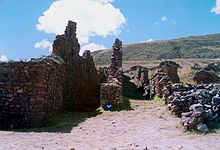
The Wari dominated an area from northern to central Peru, with their principal heart most Ayacucho. Their art is distinguished from the Tiwanaku style by the apply of bolder colors and patterns.[88] Notable among Wari finds are tapestry garments, presumed to be fabricated for priests or rulers to wear, often bearing abstract geometric designs of significant complication, but also bearing images of animals and figures.[89] Wari ceramics, also of loftier technical quality, are similar in many means to those of the preceding cultures, where local influences from fallen cultures, like the Moche, are still somewhat evident. Metalwork, while rarely found due to its desirability by looters, shows elegant simplicity and, once more, a loftier level of workmanship.[90]
Tardily Intermediate Period [edit]
Following the decline of the Wari and Tiwanaku, the northern and cardinal coastal areas were somewhat dominated by the Chimú culture, which included notable subcultures like the Lambayeque (or Sicán) and Chancay cultures. To the south, coastal cultures dominated in the Ica region, and at that place was a significant cultural crossroads at Pachacamac, near Lima.[91] These cultures would dominate from about one thousand CE until the 1460s and 1470s, as the Inca Empire began to take shape and eventually captivated the geographically smaller nearby cultures.
Chimú and Sicán Cultures

The Chimú civilisation in particular was responsible for an extremely large number of artworks. Its uppercase city, Chan Chan, appears to have independent building that appeared to part as museums—they seem to have been used for displaying and preserving artwork. Much of the artwork from Chan Chan in particular has been looted, some by the Castilian later the Spanish conquest.[91] The art from this time at times displays amazing complexity, with "multimedia" works that crave artists working together in a diversity of media, including materials believed to take come from as far away equally Key America. Items of increasing splendor or value were produced, apparently equally the society became increasing stratified.[92] At the same, the quality of some of the work declined, as need for pieces pushed product rates upwards and values downwards.[93]
The Sicán culture flourished from 700 CE to near 1400 CE, although it came under political domination of the Chimú around 1100 CE, at which time many of its artists may take moved to Chan Chan. There was significant copperworking by the Sicán, including what seems to be a sort of currency based on copper objects that look like axes.[94] Artwork includes burial masks, beakers and metallic vessels that previous cultures traditionally made of dirt. The metalwork of the Sicán was especially sophisticated, with innovations including repoussé and crush inlay. Sheet metal was also often used to encompass other works.[95]
Prominent in Sicán iconography is the Sicán deity, which appears on all manner of work, from the portable to the monumental. Other imagery includes geometric and wave patterns, likewise as scenes of fishing and shell diving.[96]
Chancay culture Chancay civilization, before information technology was subsumed by the Chimú, did not feature notable monumental fine art. Ceramics and textiles were made, just the quality and skill level was uneven. Ceramics are by and large black on white, and often suffer from flaws like poor firing, and drips of the sideslip used for colour; however, fine examples be. Textiles are overall of a higher quality, including the utilize of painted weaves and tapestry techniques, and were produced in large quantities.[97] The color palette of the Chancay was not overly bold: golds, browns, white, and scarlet predominate.[98]
Pachacamac Pachacamac is a temple site south of Lima, Republic of peru that was an important pilgrimage middle into Spanish colonial times. The site boasts temple constructions from several periods, culminating in Inca constructions that are however in relatively proficient status. The temples were painted with murals depicting plants and animals. The main temple contained a carved wooden sculpture akin to a totem pole.[98]
Ica civilisation The Ica region, which had been dominated by the Nazca, was fragmented into several smaller political and culture groups. The pottery produced in this region was of the highest quality at the time, and its aesthetics would exist adopted by the Inca when they conquered the surface area.[99]
Tardily Horizon and Inca culture [edit]

An 1860 map of Cusco. The puma shape is discernible, with the head at the upper left and the tail at the lower right.
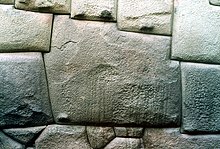
The twelve angle rock, in the Hatum Rumiyoc street of Cusco, is an example of Inca masonry.
This time period represents the era in which the civilization of the central Andes is nigh completely dominated by the Inca Empire, which began its expansion in 1438. It lasted until the Spanish conquest in 1533. The Inca captivated much technical skill from the cultures they conquered, and disseminated it, along with standard shapes and patterns, throughout their area of influence, which extended from Quito, Ecuador to Santiago, Chile. Inca stonework is notably skillful; giant stones are ready and then tightly without mortar that a pocketknife blade will non fit in the gap.[100] Many of the Inca's monumental structures deliberately echoed the natural environment around them; this is particularly axiomatic in some of the structures at Machu Picchu.[101] The Inca laid the urban center of Cusco in the shape of a puma, with the caput of the puma at Sacsayhuaman,[102] a shape that is yet discernible in aerial photographs of the city today.
The iconography of Inca art, while conspicuously drawing from its many predecessors, is still recognizably Inca. Bronzework owes a clear debt to the Chimú, as do a number of cultural traditions: the finest appurtenances were reserved to the rulers, who wore the finest textiles, and ate and drank from gilt and silvery vessels.[103] As a consequence, Inca metalwork was relatively rare, and an obvious source of plunder for the conquering Spanish.
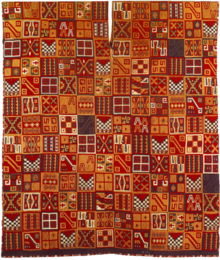
Textiles were widely prized inside the empire, in part as they were somewhat more portable in the far-flung empire.[104]
Ceramics were fabricated in big quantities, and, equally with other media, in standardized shapes and patterns. Ane common shape is the urpu, a distinctive urn shape that came in a broad variety of standard capacities, much equally modern storage containers do.[105] In spite of this standardization, many local areas retained some distinctive aspects of their civilisation in the works they produced; ceramics produced in areas under significant Chimú control prior to the Inca rule notwithstanding retain characteristics indicative of that way.[106]
Post-obit the Spanish conquest, the art of the central Andes was significantly afflicted by the conflict and diseases brought by the Spanish. Early colonial period art, began to show influences of both Christianity and Inca religious and creative ideas, and somewhen also began to encompass new techniques brought by the conquerors, including oil painting on canvas.[107]
Early ceramics in northern South America [edit]
The primeval show of decorated pottery in South America is to be found in two places. A variety of sites in the Santarém region of Brazil comprise ceramic sherds dating to a period betwixt 5000 and 3000 BCE.[108] Sites in Colombia, at Monsú and San Jacinto independent pottery finds in unlike styles, and date equally far back as 3500 BCE.[109] This is an area of active research and subject to change.[110] The ceramics were decorated with curvilinear incisions. Another ancient site at Puerto Hormiga in the Bolívar Department of Colombia dating to 3100 BCE contained pottery fragments that included figured animals in a style related to later on Barrancoid cultural finds in Colombia and Venezuela.[109] Valdivia, Ecuador too has a site dated to roughly 3100 BCE containing decorated fragments, too every bit figurines, many represent nude females. The Valdivian style stretched as far southward as northern Peru,[111] and may, co-ordinate to Lavallée, nevertheless yield older artifacts.[108]
By 2000 BCE, pottery was evident in eastern Venezuela. The La Gruta manner, oft painted in ruby-red or white, included incised animal figures in the ceramic, as well every bit ceramic vessels shaped every bit animal effigies. The Rancho Peludo style of western Venezuela featured relatively simple textile-type decorations and incisions.[111] Finds in the central Andes dating to 1800 BCE and later appear to be derived from the Valdivian tradition of Republic of ecuador.[112]
Early art in eastern Southward America [edit]
Relatively little is known well-nigh the early settlement of much of South America east of the Andes. This is due to the lack of rock (by and large required for leaving durable artifacts), and a jungle environment that rapidly recycles organic materials. Across the Andean regions, where the inhabitants were more conspicuously related to the early cultures of Peru, early finds are generally limited to coastal areas and those areas where in that location are stone outcrops. While there is prove of human being home in northern Brazil as early as 8000 BCE,[113] and rock art of unknown (or at best uncertain) age, ceramics appear to be the earliest creative artifacts. The Mina civilisation of Brazil (3000–1600 BCE) had unproblematic round vessels with a red wash, that were stylistic predecessors to later Bahia and Guyanese cultures.[111]
Southern South America [edit]
The southern reaches of Due south America show bear witness of homo habitation as far back as 10,000 BCE. A site at Arroio do Fosseis on the pampa in southern Brazil has shown reliable evidence to that time,[114] and the Tierra del Fuego at the southern tip of the continent has been occupied since 7000 BCE.[115] Artistic finds are scarce; in some parts of Patagonia ceramics were never made, only being introduced past contact with Europeans.[116]
Oceania [edit]
Australia [edit]
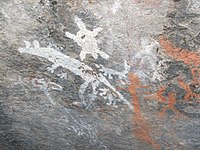
From earliest times Aboriginal and Torres Strait Islanders have been creating distinctive patterns of art. Much of the art is transitory, fatigued in sand or on the human torso to illustrate a place, a totem, or a cultural story. Early surviving artworks are mostly stone paintings. Some are chosen 10-ray paintings because they evidence the bones and organs of the animals they depict. Some Ancient fine art appears as abstract to modern viewers; Aboriginal art employs geometrical figures, dots and lines to present the story being told.
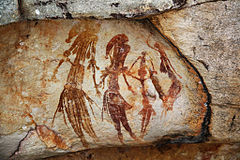
The Gwion Gwion rock art are 1 of many styles of stone art constitute in Western Australia. They are predominantly homo figures fatigued in fine detail with accurate anatomical proportioning. They are usually dated to be at least 17,000 years old, and in that location have been suggestions they are every bit much as seventy,000 years one-time.[117] The Sydney rock engravings are as well a prominent rock art site in the country.[118]
Polynesia [edit]
The natives of Polynesia have a distinct artistic heritage. While many of their artifacts were made with organic materials and thus lost to history, some of their most striking achievements survive in clay and stone. Amid these are numerous pottery fragments from western Oceania, from the late 2d millennium BCE. As well, the natives of Polynesia left scattered around their islands Petroglyphs, stone platforms or Marae, and sculptures of ancestor figures, the most famous of which are the Moai of Easter Island.
See too [edit]
- Çatalhüyük
- List of Stone Age art
- Nevalı Çori
- Prehistoric music
- Prehistoric religion
Notes [edit]
- ^ "The term "prehistoric" ceases to be valid some thousands of years B.C. in the Heart East but remains a warranted clarification down to about 500 A.D. in Ireland", Review past "A. T. 50." of Prehistoric Art by T. G. Eastward. Powell, The Journal of the Purple Society of Antiquaries of Republic of ireland, Vol. 97, No. 1 (1967), p. 95, Majestic Club of Antiquaries of Ireland, JSTOR
- ^ a b c d St. Fleur, Nicholas (12 September 2018). "Oldest Known Drawing by Human Hands Discovered in Due south African Cave". The New York Times . Retrieved 15 September 2018.
- ^ "Shell 'art' made 300,000 years before humans evolved - New Scientist". New Scientist.
- ^ a b Joordens, Josephine C. A.; d'Errico, Francesco; Wesselingh, Frank P.; Munro, Stephen; de Vos, John; Wallinga, Jakob; Ankjærgaard, Christina; Reimann, Tony; Wijbrans, Jan R.; Kuiper, Klaudia F.; Mücher, Herman J. (2015). "Human being erectus at Trinil on Java used shells for tool production and engraving". Nature. 518 (7538): 228–231. Bibcode:2015Natur.518..228J. doi:10.1038/nature13962. ISSN 1476-4687. PMID 25470048. S2CID 4461751.
- ^ New York Times
- ^ The Metropolitan Museum of New York City Introduction to Prehistoric Art Retrieved 2012-5-12
- ^ Hunt, pp. 145-146
- ^ Henshilwood, Christopher; Niekerk, Karen Loise van. "South Africa'due south Blombos cave is home to the primeval drawing by a human". The Conversation . Retrieved 2020-02-17 .
- ^ "Discovery of the earliest drawing". ScienceDaily . Retrieved 2020-02-17 .
- ^ D. Fifty. Hoffmann; C. D. Standish; M. García-Diez; P. B. Pettitt; J. A. Milton; J. Zilhão; J. J. Alcolea-González; P. Cantalejo-Duarte; H. Collado; R. de Balbín; M. Lorblanchet; J. Ramos-Muñoz; G.-Ch. Weniger; A. Westward. M. Freeway (2018). "U-Th dating of carbonate crusts reveals Neandertal origin of Iberian cave art". Science. 359 (6378): 912–915. Bibcode:2018Sci...359..912H. doi:ten.1126/science.aap7778. PMID 29472483.
- ^ Marris, Emma (22 February 2018). "Neanderthal artists fabricated oldest-known cave paintings". Nature. doi:10.1038/d41586-018-02357-8.
- ^ Feehly, Conor (6 July 2021). "Beautiful Bone Carving From 51,000 Years Ago Is Changing Our View of Neanderthals". ScienceAlert . Retrieved 6 July 2021.
- ^ Leder, Dirk; et al. (v July 2021). "A 51,000-year-old engraved os reveals Neanderthals' capacity for symbolic behaviour". Nature Ecology & Development. 594 (nine): 1273–1282. doi:10.1038/s41559-021-01487-z. PMID 34226702. S2CID 235746596. Retrieved half dozen July 2021.
- ^ a b Zimmer, Carl (vii November 2018). "In Cave in Borneo Jungle, Scientists Find Oldest Figurative Painting in the World - A cave cartoon in Kalimantan is at least 40,000 years one-time, raising intriguing questions about inventiveness in ancient societies". The New York Times . Retrieved 8 November 2018.
- ^ a b Aubert, One thousand.; et al. (7 November 2018). "Palaeolithic cave fine art in Borneo". Nature. 564 (7735): 254–257. Bibcode:2018Natur.564..254A. doi:10.1038/s41586-018-0679-9. PMID 30405242. S2CID 53208538.
- ^ "Indonesian Cave Paintings Equally One-time As Europe'south Ancient Art". NPR.org. 8 October 2014.
- ^ Portal, p. 25
- ^ a b Portal, p. 26
- ^ Coulson, pp. 150–155
- ^ Thackeray.
- ^ Azerbaijan, Azerbaijan (2005). Azerbaijan. Cavendish Square Publishing. pp. xviii. ISBN9780761420118.
- ^ Azerbaijan: Mosques, Turrets, Palaces, Azerbaijan: Mosques, Turrets, Palaces (1979). Azerbaijan: Mosques, Turrets, Palaces. Corvina Kiadó. p. 8. ISBN9789631303216.
{{cite book}}: CS1 maint: multiple names: authors list (link) - ^ A Historical Atlas of Azerbaijan (Historical Atlases of South asia, Central Asia, and The Centre East), A Historical Atlas of Republic of azerbaijan (Historical Atlases of Southern asia, Cardinal Asia, and The Eye East) (2004). A Historical Atlas of Azerbaijan (Historical Atlases of Southern asia, Central Asia, and The Heart E). Rosen Pub Grouping. p. eleven. ISBN978-0823944972.
{{cite volume}}: CS1 maint: multiple names: authors list (link) - ^ "The Rock Engravings of Gobustan". donsmaps.com . Retrieved 2019-02-07 .
- ^ Pre-Columbian Trans-Oceanic Contact. Lulu.com. 2016. p. 98. ISBN978-1329972162. [ self-published source ]
- ^ Mathpal, Yashodhar (1984). Prehistoric Painting Of Bhimbetka. Abhinav Publications. p. 220. ISBN9788170171935.
- ^ Tiwari, Shiv Kumar (2000). Riddles of Indian Rockshelter Paintings. Sarup & Sons. p. 189. ISBN9788176250863.
- ^ Rock Shelters of Bhimbetka (PDF). UNESCO. 2003. p. 16.
- ^ Mithen, Steven (2011). After the Ice: A Global Human History, xx,000 - 5000 BC. Orion. p. 524. ISBN9781780222592.
- ^ Javid, Ali; Jāvīd, ʻAlī; Javeed, Tabassum (2008). Globe Heritage Monuments and Related Edifices in India. Algora Publishing. p. 19. ISBN9780875864846.
- ^ Portal, p. 27
- ^ Portal, p. 29
- ^ Portal, p. 33
- ^ Portal, pp. 34–35
- ^ Portal, p. 38
- ^ Portal, p. 39
- ^ Portal, p. twoscore
- ^ Portal, p. 41
- ^ Sagona, Claudia (2015-08-25). The Archeology of Malta. Cambridge University Press. p. 47. ISBN9781107006690 . Retrieved 25 November 2016.
- ^ Curry, Andrew (Nov 2008). "Gobekli Tepe: The Globe'due south First Temple?". Smithsonian.com. Retrieved August 2, 2013.
- ^ Sandars, 75-98
- ^ "Rock Drawings in Valcamonica" (PDF).
- ^ Sandars, Nancy K., Prehistoric Fine art in Europe, Penguin (Pelican, at present Yale, History of Art), pp. 87-96, 1968 (nb 1st edn.)
- ^ "11,000 year sometime pendant is primeval known Mesolithic art in Britain", Academy of York
- ^ Geggel, Laura (April 25, 2018). "This Eerie, Human being-Like Figure Is Twice As Old Equally Egypt'southward Pyramids". Alive Science . Retrieved Apr 28, 2018.
- ^ Borić, Dušan; Hanks, Bryan; Šljivar, Duško; Kočić, Miroslav; Bulatović, Jelena; Griffiths, Seren; Doonan, Roger; Jacanović, Dragan (June 2018). "Enclosing the Neolithic World: A Vinča Civilisation Enclosed and Fortified Settlement in the Balkans". Electric current Anthropology. 59 (iii): 336–345. doi:10.1086/697534. hdl:11573/1545302. S2CID 150068332.
- ^ Coulson, p. 86
- ^ Coulson, pp. 80–82
- ^ Unesco World Heritage designation.
- ^ Mire, Sada (2008). "The Discovery of Dhambalin Rock Fine art Site, Somaliland". African Archaeological Review. 25 (3–4): 153–168. doi:10.1007/s10437-008-9032-ii. S2CID 162960112. Archived from the original on 27 June 2013. Retrieved 22 June 2013.
- ^ Alberge, Dalya (17 September 2010). "Uk archaeologist finds cave paintings at 100 new African sites". The Guardian . Retrieved 25 June 2013.
- ^ Coulson, p. 147
- ^ Coulson, pp. 156–160
- ^ Coulson, pp. 160–162,205
- ^ "Ice Age Art from Florida." By Horizons. 23 June 2011 (retrieved 23 June 2011)
- ^ Bement, Leland C. Bison hunting at Cooper site: where lightning bolts drew thundering herds. Norman: University of Oklahoma Printing, 1999: 37, 43, 176. ISBN 978-0-8061-3053-viii.
- ^ Friedman, Florence Dunn (September 1998). "Aboriginal Egyptian faience". Archived from the original on 2004-10-20. Retrieved 2008-12-22 .
- ^ Wilford, John Noble. Scientist at Work: Anna C. Roosevelt; Precipitous and To the Point In Amazonia. New York Times. 23 April 1996
- ^ "Dating a Paleoindian Site in the Amazon in Comparison with Clovis Culture." Science. March 1997: Vol. 275, no. 5308, pp. 194801952. (retrieved 1 November 2009)
- ^ Rock-Miller, 17
- ^ Lavallée, p. 88
- ^ Lavallée, p. 94
- ^ Lavallée, p. 115
- ^ Lavallée, p. 186
- ^ Bruhns, p. 80
- ^ Stone-Miller, pp. 19–20
- ^ Stone-Miller, p. 21
- ^ Stone-Miller, p. 27
- ^ Stone-Miller, p. 22
- ^ Stone-Miller, pp. 28–29
- ^ Stone-Miller, p. 40
- ^ Stone-Miller, p. 44
- ^ Stone-Miller, p. 46
- ^ Rock-Miller, p. 49
- ^ Stone-Miller, p. 50
- ^ Stone-Miller, p. 58
- ^ Stone-Miller, p. 67
- ^ Stone-Miller, pp. 74–75
- ^ Stone-Miller, pp. 78–82
- ^ Stone-Miller, p. 83
- ^ Stone-Miller, p. 88
- ^ Stone-Miller, p. 86
- ^ Stone-Miller, p. 92
- ^ Rock-Miller, pp. 121–123
- ^ Stone-Miller, p. 119
- ^ Stone-Miller, pp. 131–134
- ^ Stone-Miller, p. 136
- ^ Rock-Miller, pp. 138–139
- ^ Stone-Miller, pp. 146–148
- ^ Stone-Miller, pp. 149–150
- ^ a b Stone-Miller, p. 151
- ^ Stone-Miller, p. 153
- ^ Stone-Miller, p. 154
- ^ Stone-Miller, p. 156
- ^ Stone-Miller, pp. 156–158
- ^ Rock-Miller, p. 160
- ^ Stone-Miller, pp. 175–177
- ^ a b Stone-Miller, p. 179
- ^ Stone-Miller, p. 180
- ^ Stone-Miller, p. 181
- ^ Stone-Miller, p. 190
- ^ Stone-Miller, p. 194
- ^ Rock-Miller, p. 186
- ^ Stone-Miller, p. 209
- ^ Stone-Miller, p. 215
- ^ Stone-Miller, p. 216
- ^ Stone-Miller, p. 217
- ^ a b Lavallée, p. 182
- ^ a b Bruhns, pp. 116–117
- ^ Lavallée, pp. 176–182
- ^ a b c Bruhns, pp. 117–118
- ^ Bruhns, p. 119
- ^ Lavallée, p. 113
- ^ Lavallée, p. 108
- ^ Lavallée, p. 112
- ^ Lavallée, p. 187
- ^ Bradshaw Foundation. "The Bradshaw Paintings - Australian Rock Art Archive". Bradshaw Foundation.
- ^ Bowdler, Sandra. "Balls Head: the excavation of a Port Jackson stone shelter. Records of the Australian Museum 28(7): 117–128, plates 17–21. [4 Oct 1971]" (PDF). AUSTRALIAN MUSEUM SCIENTIFIC PUBLICATIONS. Australian Museum. Retrieved April 28, 2012.
References [edit]
- Arbib, Michael A (2006). Activity to language via the mirror neuron system: The Mirror Neuron System. Cambridge Academy Press. ISBN978-0-521-84755-ane.
- Bailey, Douglass (2005). Prehistoric Figurines: Representation and Corporeality in the Neolithic. Routledge Publishers. ISBN978-0-415-33152-4.
- Bruhns, Karen O (1994). Aboriginal South America . Cambridge University Printing. ISBN978-0-521-27761-7.
- Chase, Philip G (2005). The Emergence of Civilisation: The Development of a Uniquely Homo Way of Life. Birkhäuser. ISBN978-0-387-30512-7.
- Coulson, David; Campbell, Alec (2001). African Rock Fine art. Harry N. Abrams, Inc. ISBN978-0-8109-4363-vi.
- Lavallée, Danièle (1995). The First South Americans. Bahn, Paul Grand (trans.). University of Utah Press. ISBN978-0-87480-665-6.
- Portal, Jane (2000). Korea: Art and Archaeology . Thames & Hudson. ISBN9780500282021.
- Sandars, Nancy M., Prehistoric Art in Europe, Penguin (Pelican, at present Yale, History of Fine art), 1968 (nb 1st edn.)
- Rock-Miller, Rebecca (1995). Art of the Andes . Thames and Hudson. ISBN978-0-500-20286-9.
- Thackeray, Anne I.; Thackeray, JF; Beaumont, Atomic number 82; Vogel, JC; et al. (1981-10-02). "Dated Rock Engravings from Wonderwerk Cave, Southward Africa". Science. 214 (4516): 64–67. Bibcode:1981Sci...214...64T. doi:ten.1126/science.214.4516.64. PMID 17802575. S2CID 29714094.
- "Unesco World Heritage announcement on Twyfelfontein". Retrieved 2008-xi-13 .
External links [edit]
- RockArtScandinavia Tanums Hällristningsmuseum Underslös. Rock art research centre.
- EuroPreArt database of European Prehistoric Fine art
- Lepenski Vir
- Göbekli Tepe, in German
- Nevali Cori
- Prehistoric Art Expressions from India
- http://witcombe.sbc.edu/ARTHprehistoric.html#general
- http://donsmaps.com/combarelles.html
- Homo Timeline (Interactive) – Smithsonian, National Museum of Natural History (August 2016).
Source: https://en.wikipedia.org/wiki/Prehistoric_art
0 Response to "What Was the Primary Way of Expressing Art During the Stone Age?"
Enregistrer un commentaire